For parcels, the border between Switzerland and Germany is a real customs border – with import VAT, customs tariff numbers, proofs of origin and fees that, in the worst case, your customer ends up paying at the front door. This guide explains step by step what happens when goods move in either direction, which rules apply in 2026 and how to organize customs so that neither you nor your customers notice it.
Why customs apply between CH and DE at all
Switzerland is part of the Schengen Area, but not of the European Union and not of the EU customs union. For goods, this means that every shipment crossing the border is an export from one customs territory and an import into the other. There is no “intra-Community supply” as there is between Germany and Austria – instead there is a customs declaration, import VAT and, depending on the goods, a customs duty rate.
The good news: a free trade agreement has been in force between Switzerland and the EU since 1972. Goods with proven Swiss or EU origin are duty-free in both directions. And as of January 1, 2024, Switzerland has abolished industrial tariffs altogether – for most consumer goods, from clothing and cosmetics to electronics, no customs duty is charged on import into Switzerland anymore, regardless of where the goods come from. What remains is import VAT. And the obligation to declare everything correctly.
Which charges apply – in both directions
With every import, customs checks three things: what is it (customs tariff number), what is it worth (customs value) and where does it come from (origin). The charges follow from these three answers.
| Import into Switzerland | Import into Germany (EU) | |
|---|---|---|
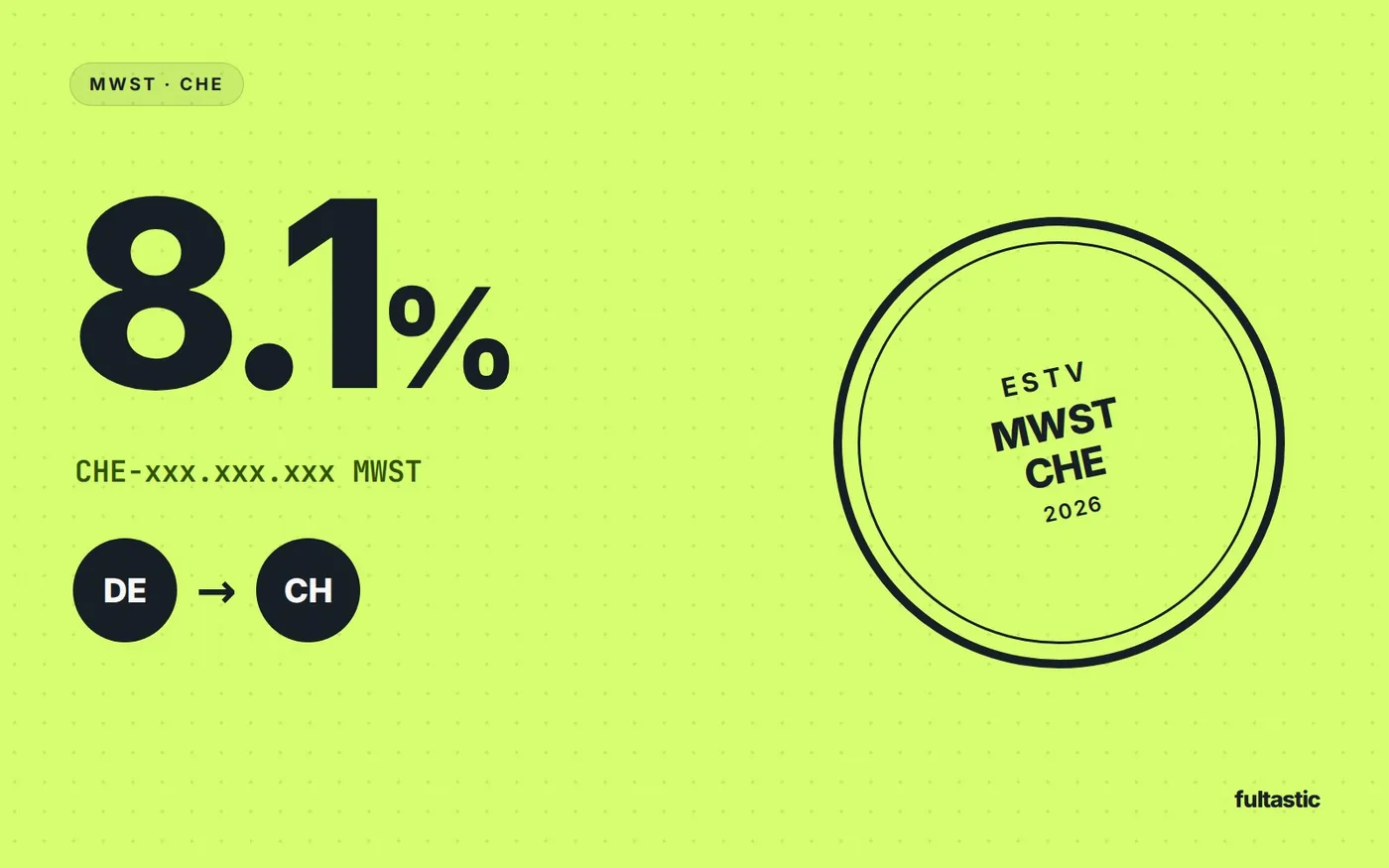
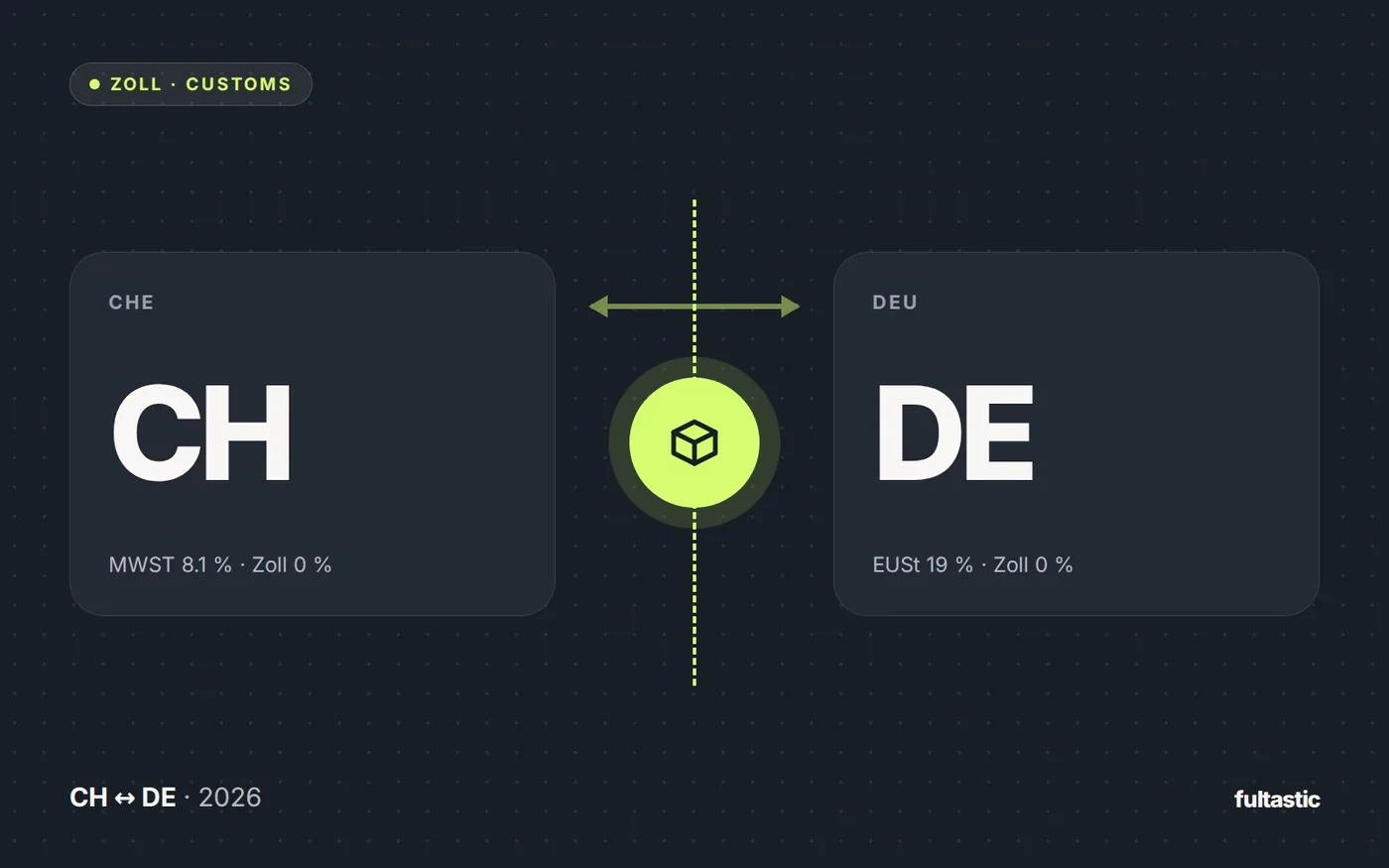
| Import VAT | 8.1 % Swiss VAT (2.6 % for food, books, medicines) | 19 % import VAT (reduced rate of 7 %, e.g. food, books) |
| Customs duty | Industrial tariffs abolished since 2024. Duties now only on agricultural products and food, plus special levies on alcohol and tobacco. | Duty rate according to the EU customs tariff (TARIC). 0 % with proven CH/EU preferential origin, otherwise usually 0–12 % depending on the goods. |
| Exemption threshold for low-value consignments | No import VAT if the tax amount is below CHF 5 – i.e. up to around CHF 62 in goods value incl. shipping (at 8.1 %). | No VAT exemption threshold anymore (since July 2021). The EUR 150 customs duty exemption is being phased out – the EU has decided to abolish it; check the current status. |
| Tax base | Goods value + shipping costs to the place of destination (+ customs duty, if any) | Goods value + shipping costs to the EU border (+ customs duty) |
| Parcel carrier's fee | Customs clearance fee charged by Swiss Post or the courier, typically CHF 10–30 per shipment, if customs clearance is left to the recipient. | Service flat fee of the parcel carrier (single-digit to low double-digit euro amount), if customs clearance is left to the recipient. |
These fees are the real conversion killer: it is not the 8.1 % import VAT that puts Swiss customers off, but the CHF 25 “customs clearance fee” for a T-shirt that they only learn about at the front door. If you sell to Switzerland, you either have to absorb this amount yourself – or avoid it entirely with the right logistics (more on that in a moment).
The documents: invoice, tariff number, origin
Customs clearance is 80 % data quality. If the following three things are correct, the declaration goes through in minutes. If not, your parcel sits in a customs warehouse.
1. The commercial invoice
Every shipment needs an invoice (a pro forma invoice for samples or replacement deliveries). It must include: sender and recipient with address, for companies the UID (Switzerland) or EORI number (EU), a precise description of the goods for each line item (“women's T-shirt, 100 % cotton” instead of “textiles”), quantity, unit and total price, currency, net and gross weight, delivery terms (Incoterm) and – crucially – the customs tariff number and country of origin for each line item.
2. The customs tariff number
The first six digits (HS code) are identical worldwide. Switzerland works with eight digits (Tares), the EU with ten (TARIC). The number determines the duty rate, the tax rate and whether permits are required. Record it once, cleanly, in your product master data – then your warehouse or customs service provider can automatically carry it over into every declaration. That is why, with us, the hs_code field is part of every article in the customer dashboard.
3. The proof of origin
Your goods only enter the EU duty-free with Swiss or EU preferential origin – and you have to prove it. Up to a shipment value of EUR 6’000 (Switzerland: CHF 10’300), an origin declaration with the prescribed wording directly on the invoice is sufficient. Above that, you need a EUR.1 movement certificate or approved exporter status. Important: “bought in Switzerland” is not an origin. A shirt produced in Asia that you store in Zurich has Asian origin – and pays the regular duty rate on import into the EU.
DAP or DDP: who pays at the border?
The delivery terms (Incoterm) determine who bears the import VAT, any customs duty and the fees. In e-commerce, two variants are relevant:
| DAP (Delivered at Place) | DDP (Delivered Duty Paid) | |
|---|---|---|
| Who pays tax, duty & fee? | The recipient – at the front door or via an invoice from the parcel carrier. | You as the retailer. Your customer pays only the shop price. |
| Customer experience | Unexpected additional charges, often higher than anticipated. The most common reason for refused deliveries and returns. | Like a domestic purchase. |
| What you need | Nothing extra – but very clear information at checkout. | A parcel carrier with a DDP service or a customs partner; in Switzerland additionally the declaration of subordination (Unterstellungserklärung Ausland) and, if you are liable for tax, a Swiss VAT registration. |
| Costs for you | No direct costs – but lost sales. | Import VAT (recoverable as input tax if you are registered) plus the parcel carrier's DDP surcharge. |
For B2C, there is really only one right answer: your customers must not notice the border at all. Either you ship DDP – or you don't ship across the border at all, but from a warehouse in the destination country.
In practice: shipping from Germany to Switzerland
You have three options for supplying Swiss customers. They differ greatly in effort, cost and customer experience.
Option A: parcel by parcel across the border, customer clears customs (DAP)
You ship as before with DHL or another carrier, enclose the invoice and the customs declaration form, and Swiss Post handles customs clearance at the recipient's expense. Simple for you, expensive and unpredictable for your customer. Add to that 5–10 days of transit time including the customs hold. Acceptable for occasional orders, but not as a strategy for the Swiss market.
Option B: parcel by parcel across the border, you clear customs (DDP)
With the declaration of subordination (Unterstellungserklärung Ausland) from the Swiss Federal Tax Administration (FTA), you import every shipment in your own name. You owe the import VAT, reclaim it as input tax and charge your customer Swiss VAT. Prerequisite: a Swiss VAT registration with a fiscal representative. Your customer receives the parcel like a domestic order – but the transit time and the customs clearance costs per parcel remain.
Option C: warehouse in Switzerland, domestic shipping
You bring your goods to a Swiss warehouse in bulk – by pallet, once or twice a month. A single customs declaration for hundreds of products, import VAT as input tax, then shipping with Swiss Post at domestic rates, next-day delivery, domestic returns. To your customer, your shop is a Swiss shop. For tax purposes, you are registered in Switzerland (fiscal representation); for logistics, you need a partner with a warehouse in Switzerland. From a few hundred shipments per month, this is almost always the cheapest option – because customs clearance is done per pallet instead of per parcel.
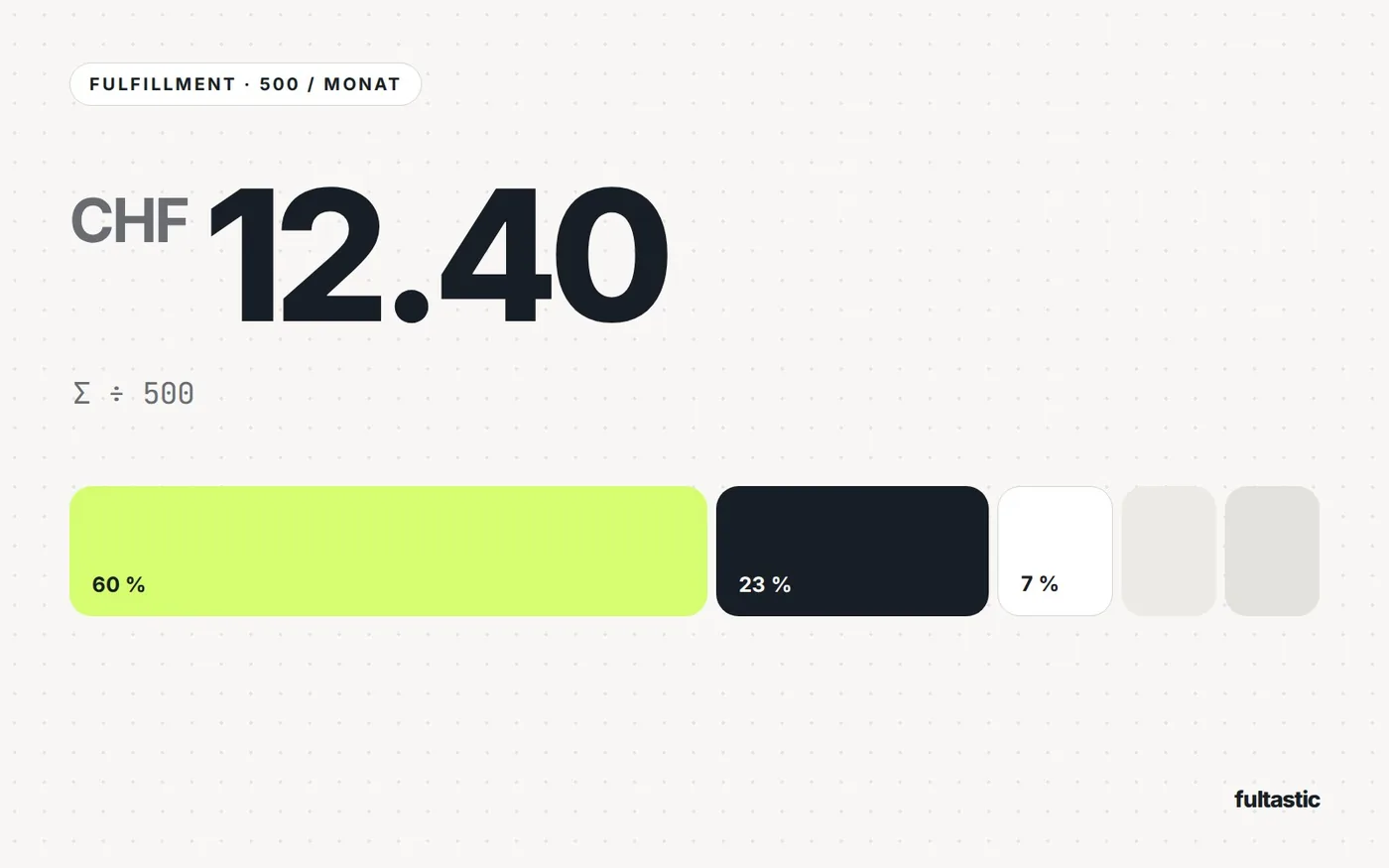
| 500 shipments per month | A: DAP individually | B: DDP individually | C: Warehouse CH |
|---|---|---|---|
| Customs declarations | 500 | 500 | 1–2 |
| Transit time to customer | 5–10 days | 3–6 days | 1 day |
| Costs at the front door | Yes | No | No |
| Postage | International | International + DDP surcharge | Domestic |
| Returns | Across the border | Across the border | Domestic |
| Swiss VAT registration | From CHF 100’000 in low-value consignments | Yes | Yes |
In practice: shipping from Switzerland to Germany and the EU
In the other direction, the same principle applies – with two special features. First: Germany is the gateway to a single market of 27 countries. Once you have cleared customs and paid tax in Germany, you can ship freely from there to the whole EU. Second: among German and European customers, the expectation of “free delivery by tomorrow” is even more pronounced than in Switzerland.
Export from Switzerland
As a Swiss retailer, you ship abroad tax-free – provided you can prove the export. For this, you need the electronic export declaration (Switzerland is switching to a new digital customs system with Passar) and the customs assessment decision as evidence. Your parcel carrier or customs partner handles this per shipment or in bulk per pallet.
Import into the EU
For parcels sent directly to end customers, the IOSS procedure is available up to a goods value of EUR 150: you account for the import VAT via a single central return, and your customer pays nothing at the door. Above that, regular import VAT applies, which you should cover under DDP. For pallet deliveries to a German warehouse, you need an EORI number, pay 19 % import VAT and reclaim it as input tax via your German VAT registration. The authority responsible for Swiss companies is the Konstanz tax office. For imports followed by deliveries to other EU countries, there is the simplified fiscal representation under § 22a UStG (German VAT Act).
The pragmatic route
Here, too: from a few hundred shipments a month, a warehouse on the EU side pays off. Your goods travel to Germany consolidated on pallets, are cleared through customs once and then go to German customers at DHL domestic rates – and to the remaining 26 countries at EU rates. For deliveries to end customers in other EU countries, you report the VAT centrally via the One-Stop-Shop procedure (OSS).
Returns across the border
What many underestimate: every return is another import. If a parcel comes back from Switzerland to Germany, German customs will in principle want import VAT again – unless you prove that it is returned goods, i.e. goods that were previously exported from the EU. For this, you need the original export declaration and the invoice. Without these documents, you pay twice. The same applies in the opposite direction.
In practice, cross-border returns handling fails on three counts: the customer has to fill in a customs form themselves, the parcel carrier charges fees again, and the goods are in transit for two to three weeks. That is why a warehouse in the customer's country pays off for returns too: the customer sends the parcel back domestically, the goods are inspected, refurbished and sold again right away – without customs. Read more on our page on returns management.
The seven most common mistakes
- Imprecise description of goods. “Clothing” or “gift” lead to queries and delays. Every line item needs material, intended use and tariff number.
- Wrong or missing origin. Without proof of origin, your goods pay the full customs duty on import into the EU, even if they were manufactured in Switzerland.
- Shipping costs not declared. They are part of the tax base. If they are missing, the customs value is estimated – usually not in your favor.
- DAP in B2C. The additional payment at the front door is the most common reason for refused deliveries. Then you pay for the return shipping and have an annoyed customer.
- Overlooking Swiss VAT liability. From CHF 100’000 in turnover from low-value consignments, you are liable for tax – retroactively, if you fail to notice.
- No documents for returns. Without proof of export, returned goods are a normal, taxable import.
- Treating food and cosmetics like textiles. For food, customs duties and declaration requirements remain in place in Switzerland; for cosmetics, labeling rules apply. Clarify this before the first shipment, not at customs.
The shortcut: a warehouse on each side
You only need to master everything in this guide on a per-parcel basis if your parcels cross the border individually. With a warehouse on each side, customs is reduced to one predictable process per pallet transport – which a partner handles for you.
This is exactly how we work at fultastic: two warehouses of our own on Lake Constance, one in Bettwiesen (Switzerland), one in Reichenau/Konstanz (Germany), just a few kilometers apart. Your goods are stored where your customers are. Our system handles the transfer between the warehouses, the customs declaration and the customs documents automatically from your product master data – in the customer dashboard, you trigger a warehouse transfer in three steps. If you only need customs clearance without warehousing, that is available separately as a customs agency service. And we take the tax side – VAT registration, fiscal representation, declaration of subordination – off your hands as well, with fiscal representation in Switzerland and fiscal representation in Germany.
In the article What does fulfillment really cost?, we work out what this costs using a concrete example.
Frequently asked questions
Do I still have to pay customs duty for Switzerland?
Not for most consumer goods anymore: Switzerland abolished industrial tariffs as of January 1, 2024. What remains is the import VAT of 8.1 % (2.6 % for food) as well as customs duties on agricultural products and special levies on alcohol and tobacco.
What is the difference between customs duty and customs clearance?
Customs duty is the charge levied on certain goods. Customs clearance is the process of declaring goods to customs – including import VAT, documents and inspection. Even duty-free goods must be cleared through customs.
How long does customs clearance take?
With complete data, a few minutes to a few hours, electronically. If there are queries – missing tariff number, unclear value, missing origin – days. For pallet deliveries to a warehouse, we usually clear customs within 24 hours of receiving the invoice.
Do I need an EORI number?
For customs declarations in the EU, yes – it identifies your company to customs. Swiss companies apply for it with German customs. In Switzerland, the UID takes on this role.
Can I book customs clearance without outsourcing warehousing and shipping?
Yes. Our customs agency can be booked separately: you provide the invoice, we check the details and file the declaration – in both directions.
What happens if I overlook the Swiss VAT threshold?
Tax liability arises automatically as soon as the conditions are met – not only upon registration. Back-payments for past periods are possible. If you are approaching the threshold, you should prepare your registration; details in our Swiss VAT guide for German brands.
Last updated: October 2026. This guide is no substitute for customs or tax advice; rates and thresholds may change. If you have specific questions about your flows of goods, get in touch with us.